
Catenulids: Catenula turgida and Suomina evelinae
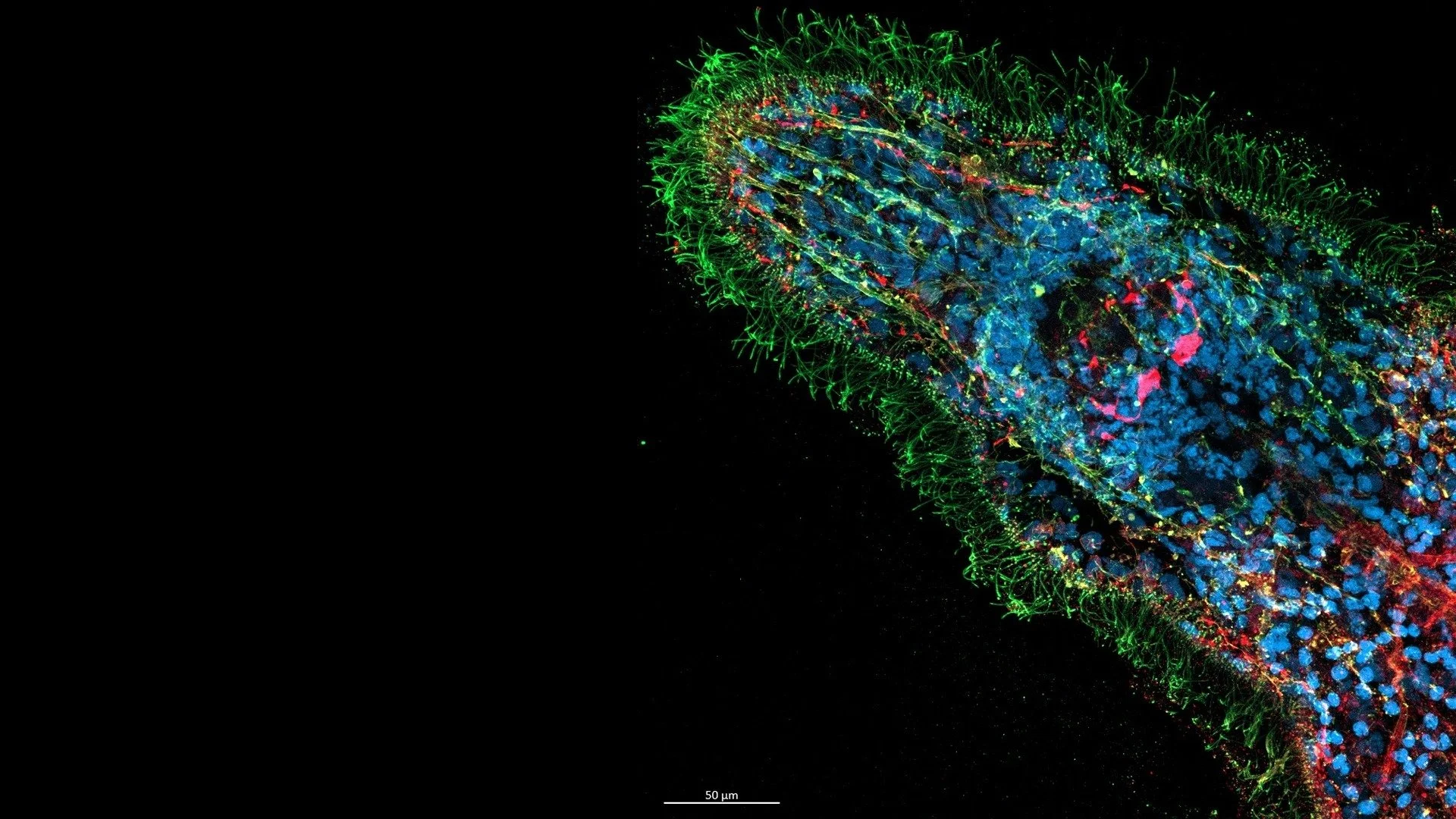
Small flatworms that form chains by dividing. The sister group of all other flatworms. Image: Tatyana Lebedeva
Catenulids are small flatworms that live mostly in fresh water. They are the sister group of all other flatworms (Laumer et al. 2015), so they help to show which flatworm traits are ancestral. Many reproduce asexually by dividing across the body, which produces chains of animals. We work with Catenula turgida and Suomina evelinae and study how their brain and their gravity-sensing organ, the statocyst, evolved.
Publications on flatworms
Martín-Durán JM, Ryan JF, Vellutini BC, Pang KS, Hejnol A (2017) A novel approach using increased taxon sampling reveals thousands of hidden orthologs in flatworms. Genome Res 27:1263-1272
Laumer CE, Hejnol A, Giribet G (2015) Nuclear genomic signals of the “microturbellarian” roots of platyhelminth evolutionary innovation. eLife 4:e05503
Adell T, Martín-Durán JM, Salo E, Cebria F (2015) Platyhelminthes. Evolutionary Developmental Biology of Invertebrates Volume 2, ed. Wanninger A, Springer Verlag, pp. 21-40
Martín-Durán JM, Egger B (2012) Developmental diversity in free-living flatworms. EvoDevo 3:7